
Hello There!
Lorem ipsum dolor sit amet, consectetur adipiscing elit,


In electrical and electronic components, flame retardancy is a baseline requirement, not an option. Whether a part houses a terminal block, forms a miniature circuit-breaker body or encloses a relay coil, the polymer has to limit fire propagation and, often, self-extinguish within defined limits. But “flame retardant” is not one property. It is a spectrum, defined by different test standards, achieved through different chemistries, and expressed differently by application. Navigating that landscape is a prerequisite for a reliable material choice.
The standards that define FR classification
UL94, the benchmark
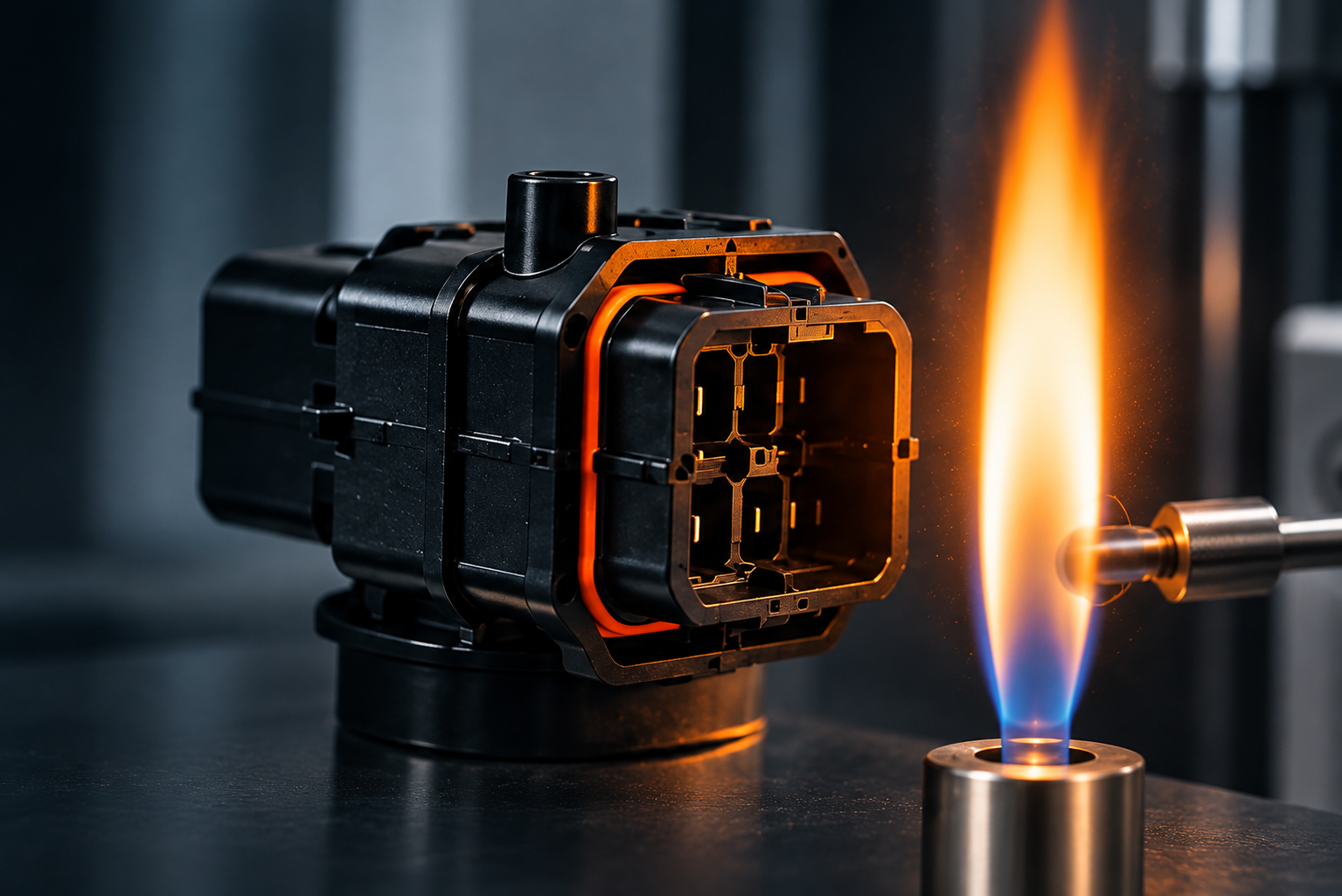
UL94 classifies plastics from HB (horizontal burn, the lowest) through V-2, V-1 and V-0 (vertical burn) to 5VA and 5VB. For most E&E housings and structural parts, V-0 at the design wall thickness is the minimum credible specification. In the V-0 test each of five specimens receives two 10-second flame applications; individual after-flame time must not exceed 10 seconds, total after-flame time for the five-specimen set must not exceed 50 seconds, and no flaming drips may ignite the cotton indicator. Wall thickness is decisive: a grade that reaches V-0 at 1.6 mm may not hold it at 0.8 mm, which is why Politem’s FR families carry thickness-specific rating data.
GWIT and GWFI, the glow-wire standards
The IEC 60695-2 series defines the Glow-Wire Ignition Temperature (GWIT) and Glow-Wire Flammability Index (GWFI), developed for parts that may face overloaded or faulty components producing localised heat without an open flame. They are required for many European installation components and increasingly specified for EV charging equipment and industrial control gear. High values such as 775 °C or 850 °C need careful formulation, because additives that help UL94 do not always improve glow-wire performance.
CTI, tracking resistance
The Comparative Tracking Index (CTI, IEC 60112) measures resistance to conductive tracking along a surface under electrical stress with contamination. High-CTI requirements (for example Material Group I, 600 V) are common in high-voltage and outdoor applications, and often pull against FR additive loading, so they need compound-level optimisation.
FR chemistry: halogenated, halogen-free and red-phosphorus-free
Halogenated systems
Brominated additives, usually with an antimony-trioxide synergist, are the most established FR chemistry, reaching V-0 at thin walls at modest loadings. However, specific brominated substances are restricted in the EU under RoHS and REACH, and a growing number of automotive and consumer-electronics OEM specifications now exclude halogenated systems.
Halogen-free (HFFR)
Halogen-free flame retardancy uses phosphorus systems (organophosphates, phosphinates), nitrogen systems (melamine derivatives), intumescent systems or combinations. HFFR is now the standard specification for most European electrical applications. The formulation challenge is matching halogenated UL94 and GWIT/GWFI performance without giving up mechanical properties, processing stability or colour consistency. Selected grades in Politem’s halogen-free FR portfolio, across PA6, PA6.6, PBT, PP and PC/ABS, achieve V-0 at thin walls and GWIT values of 775 °C and above (in-house tested; formal classification is carried out by the relevant bodies).
Red-phosphorus-free (RPF)
Red phosphorus is an effective halogen-free agent for PA, but its red-orange colour restricts colour flexibility and can contaminate shared equipment. RPF formulations use alternative phosphorus or phosphorus-nitrogen synergist systems. Politem offers RPF grades across its PA6 and PA6.6 FR families for OEM specifications that exclude red phosphorus.
Balancing FR against mechanical properties
Flame retardancy has trade-offs. FR loading reduces the reinforcement a compound can carry, limiting tensile and flexural modulus versus non-FR equivalents, and it can affect processing stability, especially at the higher melt temperatures of semi-aromatic grades. The practical implication: characterise an FR compound on the properties that matter to the part, rather than assuming it behaves like its non-FR counterpart. Politem’s application TDS data includes post-FR-loading mechanical retention.
A brief selection checklist
- Define the required UL94 class at the design wall thickness, not nominal.
- Determine whether GWIT/GWFI is required, and at what temperature.
- Check the customer or OEM spec for halogen and red-phosphorus restrictions.
- Assess CTI requirements for the voltage environment.
- Evaluate mechanical requirements after FR loading; do not assume equivalence with non-FR grades.
- Confirm processing compatibility with existing tooling and temperatures.
Conclusion
FR specification for E&E is multidimensional: test standard, FR chemistry, wall thickness, mechanical requirements and regulatory compliance all interact, and navigating them reliably takes compound-level expertise. Politem’s FR families are developed with that complexity in mind. If you are specifying an FR thermoplastic for an electrical application, start with a detailed application review rather than a grade catalogue.