
Hello There!
Lorem ipsum dolor sit amet, consectetur adipiscing elit,


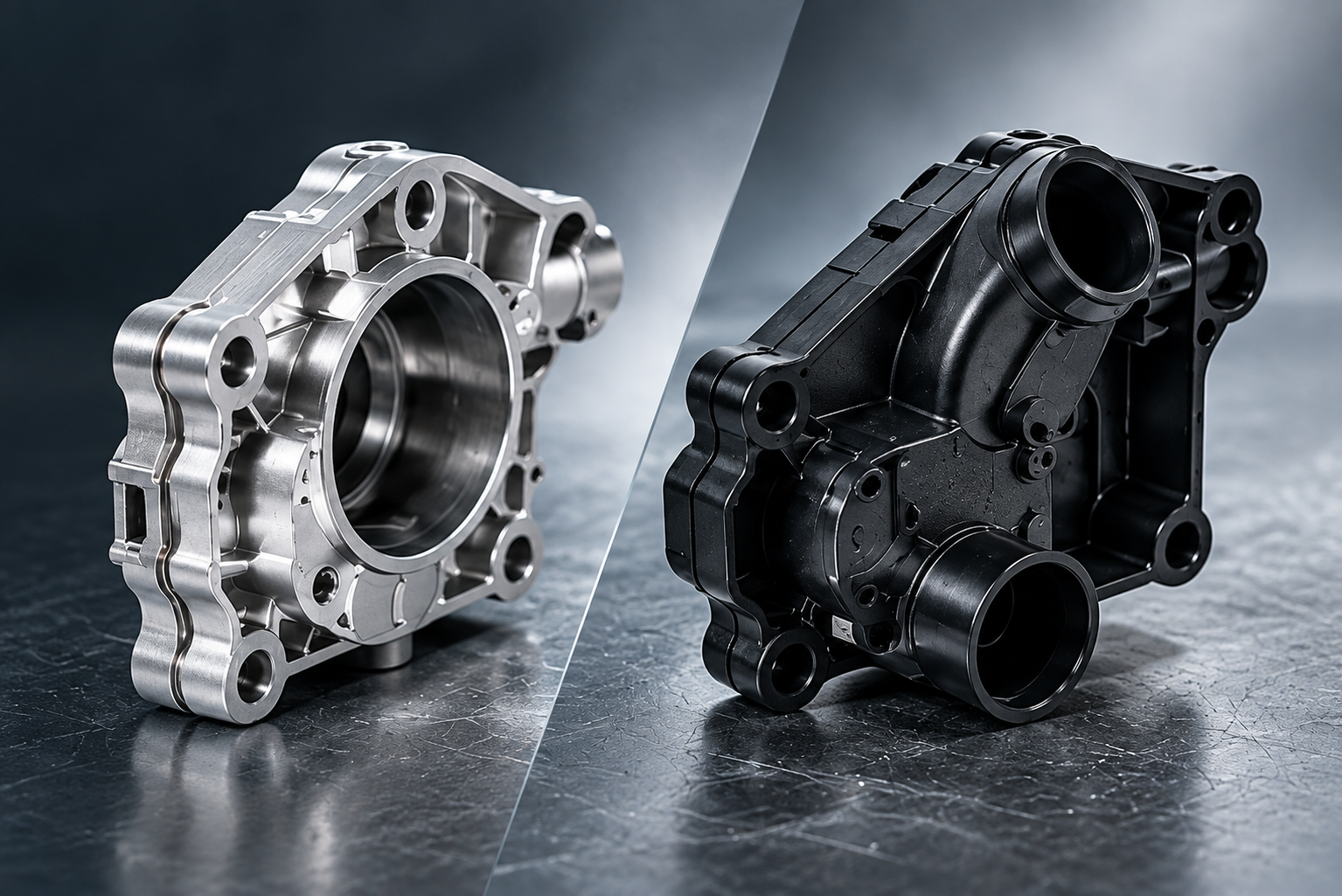
Replacing a metal part with a reinforced thermoplastic can cut weight, integrate features and remove secondary operations, but it succeeds or fails on engineering detail, not on density alone. This guide covers when metal replacement works, what reinforcement to reach for, and the design factors that decide the outcome.
Why replace metal
The gains are weight reduction, part consolidation (features moulded in a single shot), corrosion resistance, design freedom and often lower system cost. The target is to match the metal part’s functional performance, not to reproduce its material properties one-for-one.
The reinforcement ladder: glass to carbon
Glass fibre raises stiffness and strength at modest cost; Politem reinforces up to 60% glass fibre for high-stiffness structural parts. Carbon fibre goes further on stiffness-to-weight and adds conductivity, at higher cost; Politem offers up to 30% carbon fibre for the most weight-critical parts such as e-mobility structures, drones and UAVs. The base polymer is chosen with the reinforcement.
- PA6 up to 60% GF and reinforced PA6.6 for general structural parts
- PPA up to 50% GF where heat resistance is also a factor
- PA6 up to 30% CF for the most weight-critical, stiffness-driven parts
- Reinforced PP where cost and chemical resistance lead
The design factors that decide success
- Stiffness-to-weight: reinforced PA can match a metal bracket’s stiffness at a fraction of the mass, but stiffness is directional.
- Fibre orientation: properties follow flow, so gating and design set where the fibres, and the strength, end up.
- Weld lines: knit lines are the weak point in reinforced parts; keep them away from peak stress.
- Creep: under sustained load at temperature, thermoplastics creep; design for it or move to a higher-performance base.
- Dimensional stability: reinforced grades shrink differentially with fibre orientation; manage warpage in tooling and design.
- Characterise on the numbers that matter (Tensile ISO 527, Flexural ISO 178, HDT ISO 75, Charpy ISO 179).
Conductive and EMI options
Where the metal part also provided grounding or shielding, conductive and EMI-shielding compounds are available so the replacement keeps that function.
Where it is straightforward, and where to be careful
Metal replacement is most straightforward for brackets, housings, structural supports and covers. Be more careful with parts under high sustained load at high temperature (creep) and with safety-critical fatigue parts, which need full validation before conversion.
Applications
Automotive and e-mobility structures, drones and UAVs, structural brackets, machinery components, E&E housings, construction and industrial parts.
Conclusion
Metal replacement is an engineering exercise, not a material swap. Bring the metal part and its load case; Politem can advise on reinforcement and base polymer and validate against the requirement.