
Hello There!
Lorem ipsum dolor sit amet, consectetur adipiscing elit,


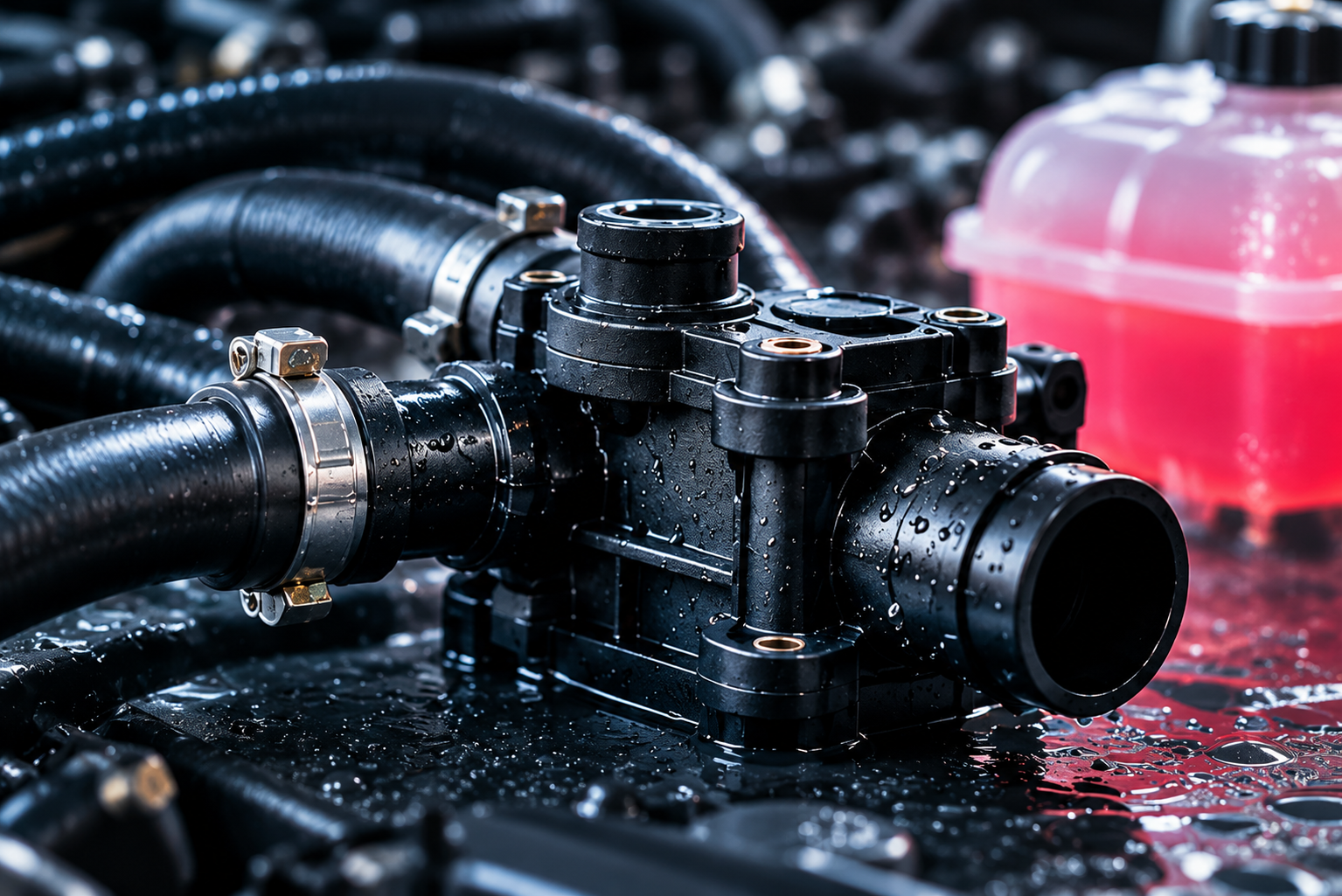
Parts that carry engine or battery coolant sit in one of the harder environments an engineering polymer meets: hot water and glycol, under pressure, for years. The failure mode is hydrolysis, the chain scission of the polyamide by water at temperature, and it does not show up in a time-zero datasheet. The number that matters is how much strength remains after prolonged ageing. This article covers the mechanism, how a hydrolysis-stabilised PA6.6-GF grade is formulated, and how it is validated.
The mechanism: why coolant ages a polyamide
Polyamides absorb water, and at coolant temperatures (commonly 100–135 °C) water and glycol drive hydrolytic chain scission, cutting molecular weight and, with it, mechanical strength. Glass fibre keeps stiffness high, but the polymer matrix carries the load transfer between fibres, so matrix degradation shows up as a loss of strength and toughness over time. A grade can look excellent at time zero and still be unfit for service if it loses too much after a thousand hours or more.
What “hydrolysis-stabilised” actually means
Stabilisation combines molecular-weight control with additive systems that slow chain scission, together with a glass-fibre coupling that holds up in the hot-fluid environment. The design goal is retained properties in the aged, wet, hot condition, not peak dry values.
The metric that matters: residual strength after ageing
Automotive coolant specifications test exactly this. Specimens are aged in a 50:50 coolant/water mixture at around 135 °C for 500 and 1000 hours, then measured for residual flexural strength, which must stay above a defined threshold after 1000 hours. Reporting time-zero strength alone is misleading for a coolant part; the aged value is the specification.
A validated Politem example
Politem’s hydrolysis-stabilised PA6.6-GF30 was independently tested at an accredited (DAkkS) automotive test laboratory and met a major automotive group’s material requirements for coolant-carrying parts, retaining its mechanical strength after 1000 hours at 135 °C in a 50:50 coolant/water mixture. This is independent test capability, not a certification or endorsement.
- Match the glass-fibre level to the stiffness requirement, then confirm the aged-property target, not just the dry one.
- Weld-line strength is the weak point in pressurised parts; place knit lines away from peak stress.
- Validate on the part under wet-hot cycling, not only on a moulded plaque.
- Connectors and quick-connects need dimensional stability held through the wet-hot service cycle.
Recycled content and hydrolysis
Hydrolysis stabilisation can be combined with recycled content where the application allows. As always, the source is treated as a technical variable, evaluated against the aged-property target rather than assumed.
Applications
Coolant pipes, reservoirs, thermostat and pump housings, quick-connectors, and e-mobility thermal-management parts running water/glycol coolants.
Conclusion
For coolant parts, specify on aged, wet, hot properties and ask for validation data, not just the datasheet. Politem can advise on grade selection and validation for your coolant, temperature and pressure case.