
Hello There!
Lorem ipsum dolor sit amet, consectetur adipiscing elit,


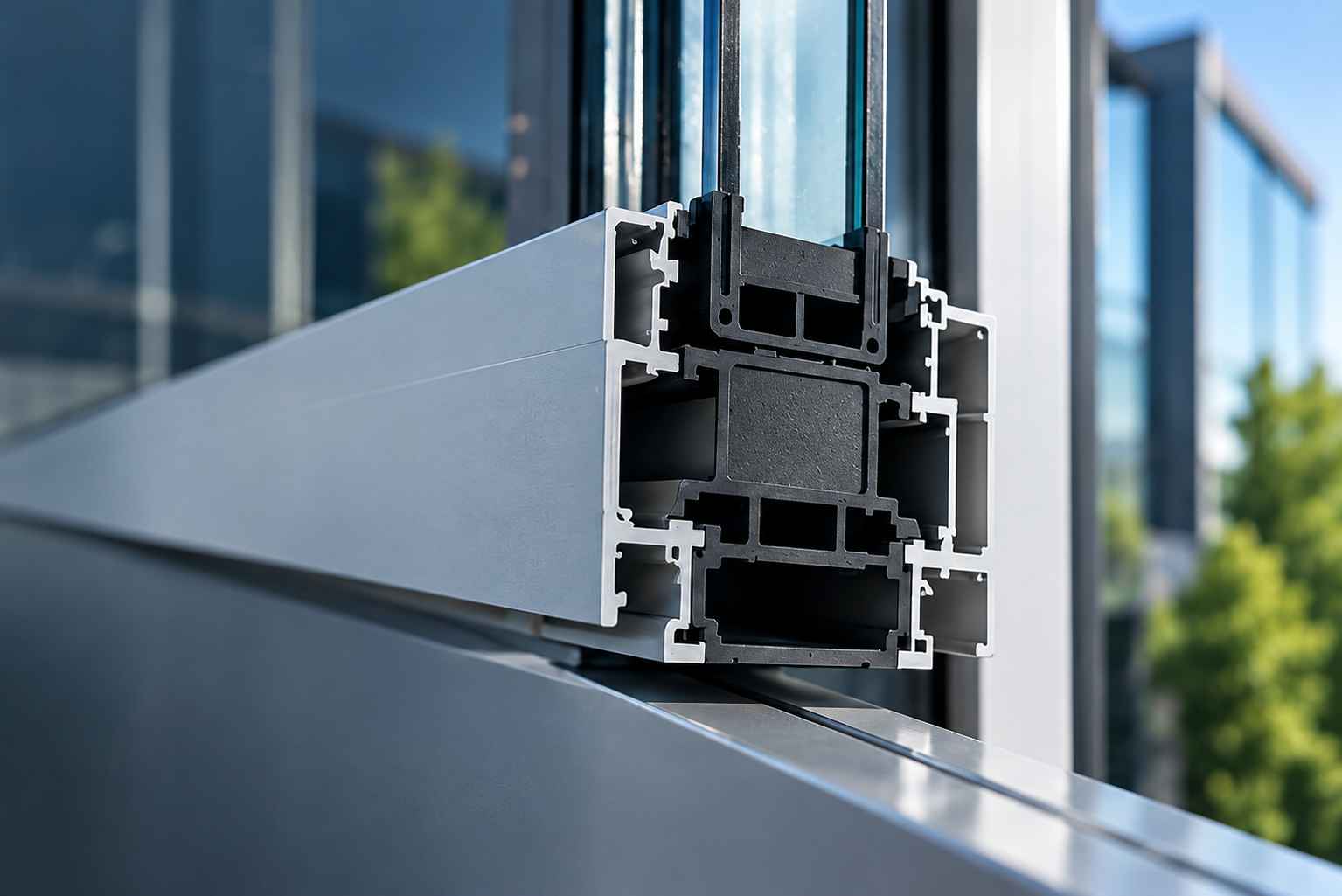
In thermally broken aluminium windows, doors and façades, a polyamide strip does the quiet, critical job of breaking the thermal bridge between the inner and outer aluminium shells. The material is almost always glass-reinforced PA6.6, and the compound has to satisfy the extrusion process as much as the finished-part performance. This article covers why PA6.6-GF, what the process demands, and how hot and cold extrusion differ.
What a thermal break does
Aluminium conducts heat readily. A thermal-break profile inserts a low-conductivity polyamide strip between the two aluminium halves, cutting the heat path while carrying structural load and holding the assembly together. Polyamide’s much lower thermal conductivity than aluminium is what makes the break work; glass reinforcement provides the strength and stiffness the profile has to carry.
Why PA6.6-GF
PA6.6 combines the mechanical strength, heat resistance and dimensional stability the application needs, and it bonds reliably into the aluminium profile during assembly. It has to survive the ovens used to cure coatings on finished aluminium, and the glass-fibre level is chosen for the structural requirement of the profile.
The process is part of the specification
A thermal-break compound is judged on how it extrudes as much as on how it performs: controlled rheology for a stable profile, dimensional accuracy, surface quality, and consistent behaviour in continuous production. A grade that meets the mechanical spec but extrudes inconsistently is not a solution.
Hot extrusion vs cold extrusion
Hot extrusion
- Stable extrusion behaviour and controlled rheology
- High mechanical performance with reduced deformation and dimensional stability
- Reliable bonding with aluminium profiles
- Consistent profile quality in continuous production
Cold extrusion
- A choice of platforms across performance and cost
- Surface smoothness and controlled flow
- Dimensional accuracy and stable geometry
- Repeatable extrusion behaviour
Politem develops dedicated PA6.6 compound technologies for both routes, in multiple glass-fibre levels, engineered around the process rather than offered as a single grade.
Recycled content
Selected thermal-break grades can be developed with recycled content where the specification allows.
Applications
Aluminium windows, doors and façade systems.
Conclusion
The right thermal-break compound is engineered around the customer’s extrusion process and the finished profile together. Politem’s PA6.6 Thermal Barrier Series covers hot and cold extrusion in multiple glass-fibre levels; ask for the series overview and match it to your profile and process.